Your cart is empty
Your cart is currently empty. Let us assist you in finding the right product.
Nobody talks about pellets the way they should.
You spend ₹25,000 on a quality PCP air rifle, you do your research on scopes, you set up a decent pellet trap at home and then when it comes to the actual ammunition, you just grab whatever's in stock and figure it'll be fine.
Sometimes it is fine. But sometimes it's the reason your groups are inconsistent, your rifle seems inaccurate, or your targets are getting punched through in ways you didn't expect.
Pellets are small. They're cheap. And they matter more than most shooters think.
This guide covers the four main pellet types you'll encounter as a .177 shooter in India flat head (wadcutter), pointed, domed, and slugs with a clear, honest breakdown of what each one actually does, when to use it, and which specific products from AirgunPro's range make sense for your shooting style.
First, Why Does Pellet Shape Even Matter?
Here's the physics in plain English.
The shape of a pellet's head determines how it cuts through air, how it transfers energy on impact, and how consistently it flies over distance. These aren't marginal differences at 15 or 20 metres; the wrong pellet choice can mean the difference between tight groups and a frustrating session that makes you question your technique.
At shorter distances (under 10 metres), honestly, shape matters less. But once you start shooting at 10 metres and beyond and especially if you've added a scope, your pellet choice starts showing up very clearly in your results.
Grain weight matters too. Heavier pellets (10–13 grain) fly slower but are more stable in wind and retain energy better at distance. Lighter pellets (8–9 grain) move faster and are generally better for short-to-medium range target shooting where velocity is an advantage.
Now, to the shapes.
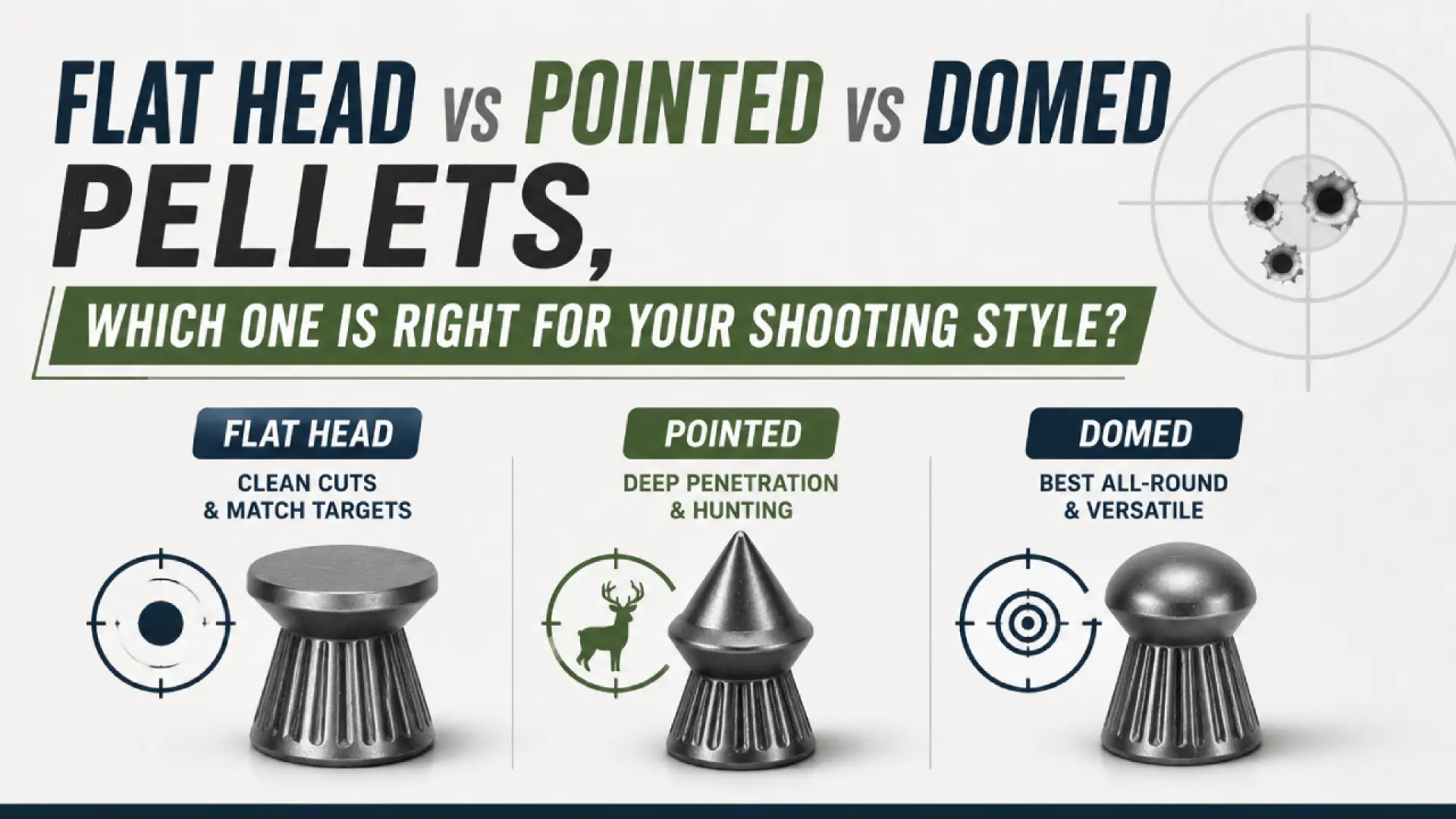
A flat head pellet also called a wadcutter, has a perfectly flat, disc-like nose. When it hits a paper target, it punches a clean, precise circular hole rather than tearing or deforming the paper around the entry point.
That clean hole is the whole point.
In competitive shooting, scoring is done by measuring exactly where the pellet cut the target. A clean, well-defined hole is easier to score accurately and consistently. This is why wadcutters are the standard pellet at Olympic-level 10m air rifle competitions and why most serious club shooters in India use them for practice on paper.
Best for: Paper target shooting, indoor practice, competition preparation, any session where you're measuring group size and precision.
Not ideal for: Long-range shooting (beyond 15 metres, the flat nose creates drag and the pellet loses stability), or anything other than targets.
→ Precipell Match 8.2 Grain 0.177 ₹500 The match-grade flat head pellet in the AirgunPro range. At 8.2 grains it's light and fast ideal for 10 metre paper target shooting. The "Match" designation means it's made to tighter tolerances than standard pellets, giving you more consistent head diameter and skirt flare from pellet to pellet. If you're working on your groups and want the pellet to stop being a variable, this is the one. → View Precipell Match 8.2 Grain
→ Precipell Field Target 8.7 Grain 0.177 ₹499 Slightly heavier than the Match at 8.7 grains, with a flat-ish nose profile suited for field target shooting at slightly longer distances. A versatile everyday practice pellet at an excellent price point. → View Precipell Field Target 8.7 Grain
Pointed pellets are exactly what they sound like: they have a sharp, conical tip rather than a flat or rounded head.
That pointed tip does one thing very well: it penetrates. The energy from the shot is concentrated at a single point on impact, driving the pellet deeper into the target material.
In practical terms, this makes pointed pellets great for pest control at short to medium range, hitting a target with enough penetration to be decisive. For purely sporting use in India, most target shooters don't need this characteristic, but pest control is a legitimate use case that many rural and semi-urban airgun owners have.
The downside is accuracy. The pointed tip is actually aerodynamically less stable than a dome at longer ranges. Past 10–12 metres, the flight path of a pointed pellet is slightly less predictable than a domed pellet of similar weight. For tight group work, you'll notice.
Best for: Pest control at close to medium range, reactive targets, short-distance shooting where penetration matters.
Not ideal for: Paper target precision work or long-range accuracy.
→ Apolo Pointed 13 Grain 0.177 ₹750 At 13 grains, this is a heavy pointed pellet which actually helps offset some of the aerodynamic instability. Heavier pointed pellets are more stable than light ones. Good for pest control where you need decisive energy transfer and reliable penetration at typical shooting distances. → View Apolo Pointed 13 Grain
→ Precipell Sting 9.6 Grain 0.177 ₹500 A mid-weight pointed option. The "Sting" name tells you what it's designed for decisive, focused impact. At 9.6 grains, it's lighter and faster than the Apolo, making it a solid option for reactive shooting at closer range. → View Precipell Sting 9.6 Grain
If you had to pick one pellet type for general shooting and could only ever use one, most experienced airgunners would tell you to pick domed.
A domed pellet has a smooth, rounded nose sometimes called a "diabolo" shape. That rounded profile cuts through air more efficiently than either a flat head or a pointed tip, which means it retains velocity better over distance and flies a more stable, predictable arc.
In practical terms: at 15, 20, and 25 metres, a quality domed pellet will consistently outperform both flat head and pointed pellets for raw accuracy. The flat head loses stability. The pointed tip creates unpredictable drag. The dome just... works.
Domed pellets are the go-to choice for outdoor shooting, field target competitions, longer-range practice, and any time you're shooting beyond the 10-metre mark.
Best for: Longer-range accuracy (15–25m), outdoor shooting, field target sport, general-purpose practice where versatility matters.
Not ideal for: Close-range competition target work where the clean hole of a wadcutter is important for scoring.
→ Apolo Domed 9 Grain 0.177 ₹699 The lighter domed option. At 9 grains it moves fast and is excellent for shooting at 10–15 metres where velocity gives you a flatter trajectory and less holdover. Great all-rounder for shooters who do most of their practice indoors or on a medium-length terrace. → View Apolo Domed 9 Grain
→ Apolo Domed 11 Grain 0.177 ₹699 The heavier domed option and the one I'd point most shooters toward for general use. At 11 grains it's more stable in wind, holds its trajectory better at 20+ metres, and hits with noticeably more authority than a 9-grain pellet. If you're doing any outdoor shooting or shooting beyond 15 metres, start here. → View Apolo Domed 11 Grain
Slugs are a newer category in the .177 airgun world. Unlike traditional diabolo-shaped pellets (which have a pinched waist and flared skirt), slugs are solid cylindrical projectiles like tiny bullets.
That solid, consistent shape makes them extremely accurate at longer distances, typically 25 metres and beyond, where the aerodynamic advantages of the slug shape really come into their own. They're heavier, they fly straighter at range, and they hit harder.
The tradeoff is that slugs require a higher-powered rifle to stabilise properly. At lower power levels, a slug may actually perform worse than a good domed pellet. If your rifle is running at the lower end of the legal power range, slugs may not be the right choice yet.
For PCP rifles in AirgunPro's premium range (PX100, PX120), slugs are worth experimenting with once you've got your basics dialled in.
Best for: Long-range precision shooting (25m+), experienced shooters wanting to push their effective range.
Not ideal for: Beginners, lower-powered rifles, indoor short-range practice.
→ Rifle Slug Series 10.03 Grain 0.177 ₹899 Entry point into slug shooting. The 10.03-grain weight makes it suitable for a wider range of .177 PCP rifles without needing extreme power. → View Rifle Slug Series 10.03 Grain
→ H&N HP Slug 13 Grain ₹1,149 The premium slug in the range. H&N is one of the most respected pellet manufacturers in the world, and their HP Slug is engineered for consistency and long-range performance. At 13 grains it's designed for higher-powered PCP rifles that can properly stabilise the heavier projectile. → View H&N HP Slug 13 Grain
→ Rifle Super Magnum Heavy 10.03 Grain 0.177 ₹850 A heavy traditional pellet rather than a true slug, but worth mentioning here for shooters wanting extra downrange energy without going full slug. Good middle ground. → View Rifle Super Magnum Heavy 10.03 Grain
Quick Decision Guide
| Your Shooting Style | Best Pellet Type | Recommended Product |
|---|---|---|
| Indoor paper targets, 10m | Flat Head (Wadcutter) | Precipell Match 8.2 Grain |
| General practice, all-round | Domed | Apolo Domed 11 Grain |
| Longer range, 15–25m | Domed (heavy) | Apolo Domed 11 Grain |
| Pest control, short range | Pointed | Apolo Pointed 13 Grain |
| Long-range precision, 25m+ | Slug | H&N HP Slug 13 Grain |
| Field target competitions | Domed or Field Target | Precipell Field Target 8.7 Grain |
Buy three or four different pellets. Shoot 20–30 of each through your specific rifle. Measure your groups.
No two rifles shoot all pellets the same way. A pellet that's legendary in a PX120 Minotaur might underperform in a PP100 Harpy and vice versa. The only way to find your rifle's favourite pellet is to run a basic pellet test with different types and different weights, at your typical shooting distance.
It takes one afternoon. Once you've found the pellet your rifle loves, stick with it and buy in quantity. Consistency in your ammunition is one of the fastest ways to improve your groups without changing anything else about your shooting.
Frequently Asked Questions
Q: Which pellet is best for .177 air rifle target shooting in India? For paper target shooting at 10 metres, flat head (wadcutter) pellets like the Precipell Match 8.2 Grain give you the cleanest holes and best scoring consistency. For longer distances, switch to a quality domed pellet like the Apolo Domed 11 Grain.
Q: What is the difference between domed and pointed .177 pellets? Domed pellets have a rounded nose that's aerodynamically efficient, better for accuracy at medium to long range. Pointed pellets have a sharp conical tip that penetrates deeper on impact better for pest control at shorter ranges, but less accurate at distance.
Q: Are heavier or lighter pellets better for accuracy? It depends on the distance and your rifle's power. For longer ranges (15m+), heavier pellets (10–13 grain) are generally more stable and accurate. For short-range indoor shooting, lighter pellets (8–9 grain) are faster and offer a flatter trajectory.
Q: What are airgun slugs and are they legal in India? Slugs are solid cylindrical pellets designed for long-range precision. .177 calibre slugs that keep total muzzle energy under 20 joules are legal in India. They work best in higher-powered PCP rifles.
Q: How many pellets does a tin usually contain? Most standard airgun pellet tins contain 200–500 pellets depending on the brand and weight. AirgunPro lists pack quantities on each product page.


Buy ₹100 more to get free shipping
Your cart is currently empty. Let us assist you in finding the right product.