Your cart is empty
Your cart is currently empty. Let us assist you in finding the right product.
Of all the questions AirgunPro customers ask before buying a scope, this one comes up the most.
"What's the difference between FFP and SFP? Which one do I need?"
It's a fair question - and the honest answer is that most online resources either oversimplify it ("FFP is better for long range!") or go so deep into the ballistics that you end up more confused than when you started.
This guide gives you the real, practical answer - specifically for .177 air rifle shooting in India, which is a different context from the big-calibre rifle shooting most scope guides are written for.
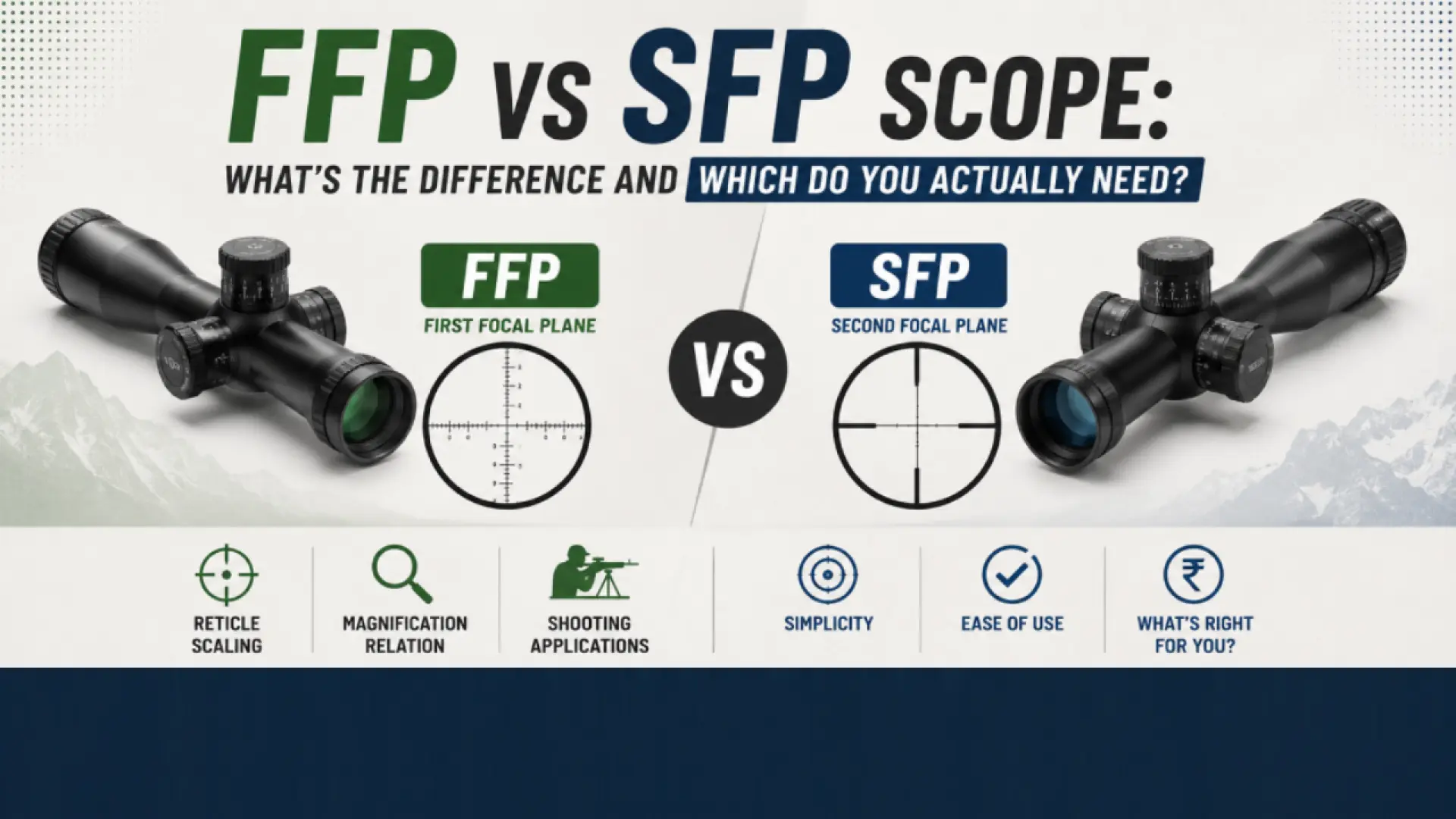
Both FFP and SFP refer to where the reticle (the crosshairs you see when you look through the scope) sits inside the optical system.
FFP = First Focal Plane. The reticle sits at the front of the magnification system - before the lenses that magnify the image. This means as you increase magnification, the reticle appears to grow along with the target image. The reticle and the target scale together.
SFP = Second Focal Plane. The reticle sits behind the magnification system. This means the reticle stays the same size regardless of what magnification you're using - only the target image grows as you zoom in.
That's the optical difference. Now here's why it matters practically.
Most modern scopes have reticles with ranging marks - small dots, hash marks, or mil-dots that you can use to estimate distance or compensate for bullet drop (or in our case, pellet drop).
These marks are designed to be accurate at a specific magnification.
On an SFP scope, the ranging marks are only accurate at the maximum magnification setting. If you shoot at 6x on a scope calibrated at 12x, your ranging marks are effectively wrong - the image has changed size but the reticle hasn't.
On an FFP scope, because the reticle scales with magnification, the ranging marks are accurate at any magnification setting. Whether you're at 6x or 24x, the holdover marks work correctly.
Does This Actually Matter for .177 Air Rifle Shooting in India?
Here's the part that most scope guides miss - and it's important.
For the vast majority of Indian airgun shooters practicing at 10–25 metres on a home terrace, backyard, or indoor range, this difference is largely irrelevant in practice.
Here's why:
At 10 metres, pellet drop is minimal. At 15 metres, your scope is zeroed and you're shooting flat. Even at 20–25 metres, the holdover involved is small enough that experienced shooters compensate naturally without using reticle marks for calculation.
The FFP/SFP distinction becomes genuinely important when you're shooting at variable distances where you're actively changing magnification and using the reticle for ranging - which is mainly field target competition or longer-range outdoor shooting.
For a beginner or intermediate shooter doing regular home practice: either works perfectly well. Don't let the FFP/SFP debate become the reason you don't buy a scope.
That said, there are some clear situations where one is better than the other - and if you're going to invest ₹11,000–₹55,000 in a scope, it's worth knowing which one fits your plans.
Choose an FFP scope if:
You shoot at variable distances and change magnification regularly. Field target shooting, for example, involves targets at different unknown distances. You're dialling your magnification up and down between shots. With FFP, your mil-dot holdover marks are always accurate - you can range a target at 8x and shoot at 16x knowing your reticle math still checks out.
You prefer to use the reticle for holdover rather than adjusting turrets. Some shooters zero their scope at one distance and then use reticle marks to compensate for other distances without turning turrets. FFP makes this more reliable.
You want a scope that grows with your skills long-term. If you think you'll eventually move into field target competition or longer-range shooting, FFP is the more capable platform.
→ Discovery HT Gen II 4-16A-44 SFIR FFP Scope - ₹19,000 The entry point into FFP optics in AirgunPro's range. 4–16x magnification, 44mm objective lens, side focus (AO), illuminated reticle. For an Indian shooter moving into field target or wanting the FFP advantage without spending flagship money, this is the sweet spot. The SFIR designation means Side Focus, Illuminated Reticle - both useful features for variable lighting conditions. → View Discovery HT Gen II 4-16x44 FFP
→ Discovery HT Gen II 6-24A-44 SFIR FFP Scope - ₹22,000 Same optical family, higher magnification ceiling. If you're shooting beyond 20 metres regularly and want the extra zoom for longer-range work, the 6–24x version gives you that headroom. The FFP reticle scales accurately across the full magnification range. → View Discovery HT Gen II 6-24x44 FFP
→ Element Helix Gen 2 6-24A-50 FFP Scope - ₹55,000 The flagship. Element Optics is a premium British optics brand, and the Helix Gen 2 is their best-in-class offering in AirgunPro's range. The 50mm objective lens gathers more light - relevant for early morning or late evening sessions on a terrace. Crystal-clear glass, precise turrets, excellent build quality. For the serious shooter who wants optics that will still be delivering at the highest level years from now. → View Element Helix Gen 2 6-24x50 FFP
Choose an SFP scope if:
You always shoot at maximum magnification. If you zoom to max and leave it there for every shot - which many target shooters do - the SFP limitation doesn't apply. Your reticle marks are accurate because you're always at the magnification they're designed for.
You shoot at a fixed distance. If your setup is a fixed 10-metre indoor range and your zero is dialled in, you don't need reticle ranging marks. You're using the scope as a precision aiming device, not a ranging tool. SFP is perfectly suited for this.
You're starting out and want to keep things simple. SFP scopes are generally straightforward - zoom in, aim, shoot. No mental adjustment needed for reticle scaling. For someone building their fundamentals, this simplicity is genuinely valuable.
You want strong optics at a lower price. SFP manufacturing is simpler, and comparable glass quality costs less in SFP than FFP. AirgunPro's Discovery SFP range delivers excellent optical performance at very competitive prices.
→ Discovery 3-12A-42 AOAC SFP Scope - ₹11,000 AirgunPro's most accessible scope. 3–12x magnification, 42mm objective, side focus (AO), centre illumination (AC). For a beginner who wants quality glass on their PP100 Harpy or SDB Panther without spending more than necessary on optics, this delivers genuine performance. Accurate, clear, and well-built for the price. → View Discovery 3-12x42 AOAC SFP
→ Discovery MS 2-10A-40 IR SFP Scope - ₹13,000 A 2–10x variable with illuminated reticle. The lower magnification floor (2x) makes this a versatile option for shooters who occasionally need wide field of view - useful if you're doing reactive target shooting or shooting in tight indoor spaces where you don't need maximum zoom. → View Discovery MS 2-10x40 IR SFP
→ Discovery MS 4-16A-44 SFIR 30mm Tube - ₹13,000 Same price as the 2-10x model but with higher maximum magnification (16x) and a 30mm tube diameter - which allows more light transmission and gives more adjustment range in the turrets. If you're planning to shoot at 20+ metres and want the zoom to match, this is the better pick over the 2-10x. → View Discovery MS 4-16x44 SFIR 30mm
→ DISCOVERYOPT VT-R 6-24x42 AOAC 25.4mm Tube - ₹12,000 High magnification SFP at a sharp price. The 6–24x range gives you serious zoom capability - at max power on this scope, a target at 20 metres is very clearly resolved. Good for shooters who want the detail of high magnification without the FFP premium. → View Discovery VT-R 6-24x42
→ Discovery WG 1.2-6A-24 IRAI 30mm Tube - ₹14,000 A low-magnification scope (1.2–6x) for shooters who prioritise field of view over zoom. Useful for reactive shooting, close-to-medium range practice, or as a secondary scope on a pistol-format rifle. The wide field of view at 1.2x makes target acquisition fast. → View Discovery WG 1.2-6x24 IRAI
The Scope Glossary You Actually Need
These abbreviations appear on every scope listing and confuse nearly every first-time buyer. Here's what they mean:
AO / AO-A - Adjustable Objective. The front lens ring can be turned to focus the image at different distances - critical for air rifle shooting where you're often much closer than the factory focus distance. Always get AO.
IR - Illuminated Reticle. The crosshairs light up (usually red/green) for low-light visibility. Useful for dawn/dusk shooting on a terrace or in a dimly lit indoor space.
SFIR - Side Focus, Illuminated Reticle. Side focus is the same as AO but the focus adjustment is on the left side of the scope body rather than the front lens. Generally easier to adjust without disturbing your hold.
30mm Tube vs 25.4mm (1 inch) Tube - The outer diameter of the scope body. 30mm tubes allow more internal adjustment range (turret travel) and marginally more light transmission. Requires 30mm scope rings - make sure your mounts match.
FFP / SFP - First/Second Focal Plane. As covered above.
Side-by-Side Recommendation Summary
| Shooting Situation | Recommended Scope | Price |
|---|---|---|
| Beginner, fixed 10m range | Discovery 3-12x42 AOAC SFP | ₹11,000 |
| General practice, 10–20m | Discovery MS 4-16x44 SFIR 30mm | ₹13,000 |
| High zoom, budget-conscious | Discovery VT-R 6-24x42 SFP | ₹12,000 |
| Wide FOV, reactive shooting | Discovery WG 1.2-6x24 IRAI | ₹14,000 |
| Field target, variable range | Discovery HT Gen II 4-16x44 FFP | ₹19,000 |
| Serious long-range (20–25m+) | Discovery HT Gen II 6-24x44 FFP | ₹22,000 |
| Premium, competition-level | Element Helix Gen 2 6-24x50 FFP | ₹55,000 |
Q: Is FFP better than SFP for air rifle shooting? Not necessarily. FFP is better if you shoot at variable magnification and use the reticle for ranging. SFP is perfectly fine - and simpler - for fixed-distance target shooting. For most Indian airgun hobbyists, the best SFP scope is a better investment than a mediocre FFP scope.
Q: What magnification do I need for 10 metre air rifle shooting? A 3–4x fixed or variable scope is more than adequate for 10m shooting. Higher magnifications (8–16x) become valuable as you push out to 15–25 metres. The Discovery 3-12x42 covers both ranges well.
Q: Do I need an illuminated reticle? Not essential, but useful. If you shoot in mixed lighting - indoor rooms, early morning terrace sessions - an illuminated reticle makes a noticeable difference to how clearly you can see your crosshairs against a target.
Q: What is side focus (SF / SFIR) on a scope? Side focus allows you to adjust the scope's focus for different distances using a dial on the left side of the scope body. It does the same job as an adjustable objective (AO) lens ring but is more convenient to use without changing your hold on the rifle.
Q: Which scope fits the PP100 Harpy or PX100 Achilles? Both use standard 1-inch (25.4mm) or 30mm scope rings depending on the scope. The Discovery 3-12x42, 4-16x44, and Element Helix all pair well with the PP100 and PX100 range. Make sure you have the correct ring diameter for whichever scope you choose.



Buy ₹100 more to get free shipping
Your cart is currently empty. Let us assist you in finding the right product.